
Dolton City Directory Holdings
The verified shelf is small but precise. Newberry Library's Illinois inventory lists Dolton within a Riverdale/Dolton grouping for 1922 through 1925 and again for 1928 through 1929. That inventory proves the place and years, but not the publisher of every volume. The title page must be checked before calling an early Dolton book a Polk directory. South Suburban Genealogical & Historical Society adds regional directories, telephone books, maps, and local files. Dolton Public Library supplies database access and local newspaper discovery rather than claiming a complete printed run.
| Collection | Verified years | Where held | Access |
|---|---|---|---|
| Riverdale/Dolton directory inventory | 1922-1925; 1928-1929 | Newberry Library | Research library, guide, selected digital items |
| Chicago and regional directories | Chicago 1871-1917, 1923, 1928-1929 | South Suburban Genealogical Society | Public, non-circulating library |
| Dolton/Riverdale telephone books | 1974-1977 and 1985 in a 1999 survey | Dolton Public Library and regional collections | Confirm present shelf status |
| Calumet Region Community Collection | 1850-2021 | Chicago Public Library | Open Special Collections material |
No authoritative source located a dedicated Dolton reverse-directory run. Do not fill that gap by treating every Chicago book as Dolton coverage. Search the catalog by year, Riverdale/Dolton grouping, and nearby Calumet place names, then inspect the title page and locality section.
Dolton Directory Research at the Library
The Dolton Public Library database desk at 14037 Lincoln Avenue is the local starting point. Its resource list includes NewsBank, historical and current Chicago Sun-Times coverage, the Chicago Daily News Historical Archive, newspapers.com, EBSCO, and Ancestry. The library lists 708-849-2385 and Monday through Saturday, 9 a.m. to 6 p.m. Subscription terms vary, so ask whether a database is available from home or only inside the building.
The library's genealogy resource list points to FamilySearch, Freedmen's Bureau material, Illinois death resources, military indexes, cemetery tools, and regional sites. Those sources help when a city directory entry gives only initials or when a family vanishes between available years.
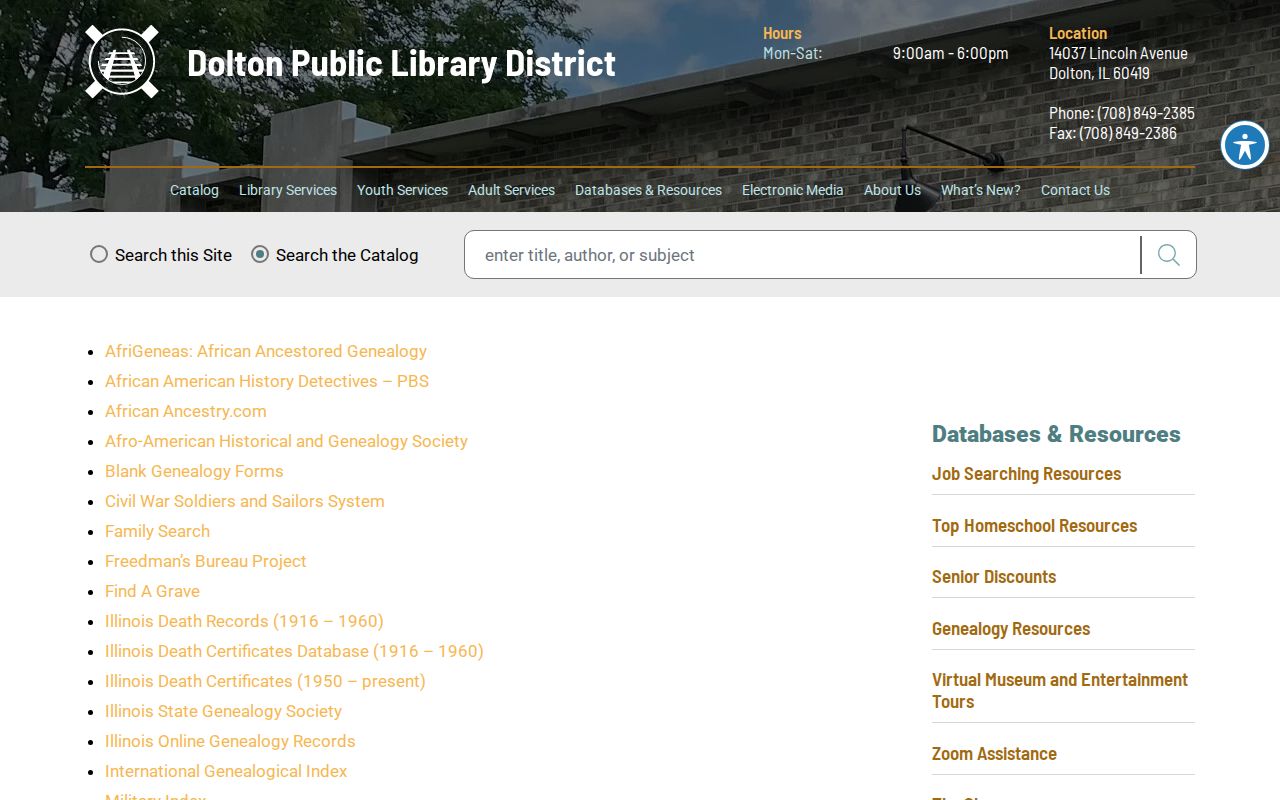
The genealogy screen supplies the next source categories to test after a directory entry, while each linked collection retains its own access and coverage rules.
The library database menu shows the mix of newspaper, genealogy, and subscription routes available to a Dolton researcher.
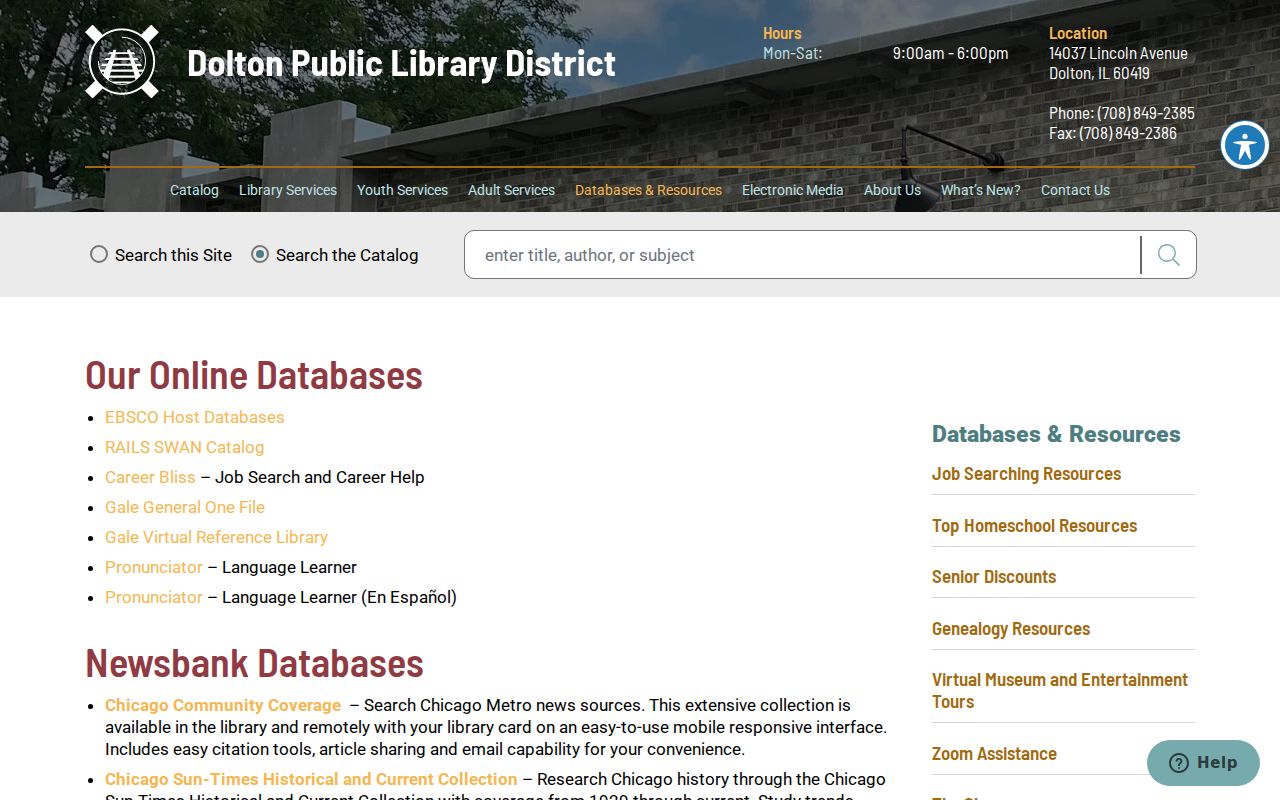
The screen is a discovery point, not proof that every named database includes every Dolton year. Confirm coverage before relying on a search result.
Search Dolton Directories at Newberry
Newberry Library is the source for the verified Dolton year inventory and for the broader Chicago directory research method. Its guide describes print and microfilm holdings, complete Chicago runs through 1928-1929, and in-building access to subscription genealogy tools. Start with the inventory to identify a likely year, then use the catalog and staff guidance to identify the exact volume. If a digital scan exists, save the stable item link as well as the page image.
Check the title page before naming a publisher. The known Polk sample demonstrates how a printed entry reads, but the research did not verify that every Dolton-labeled volume from 1922 through 1925 was published by R. L. Polk & Co. That distinction matters in a citation. A useful citation includes the printed title, publisher shown inside that volume, year, page, repository, and date viewed.
The Newberry city directory guide explains how the library organizes and serves these holdings.
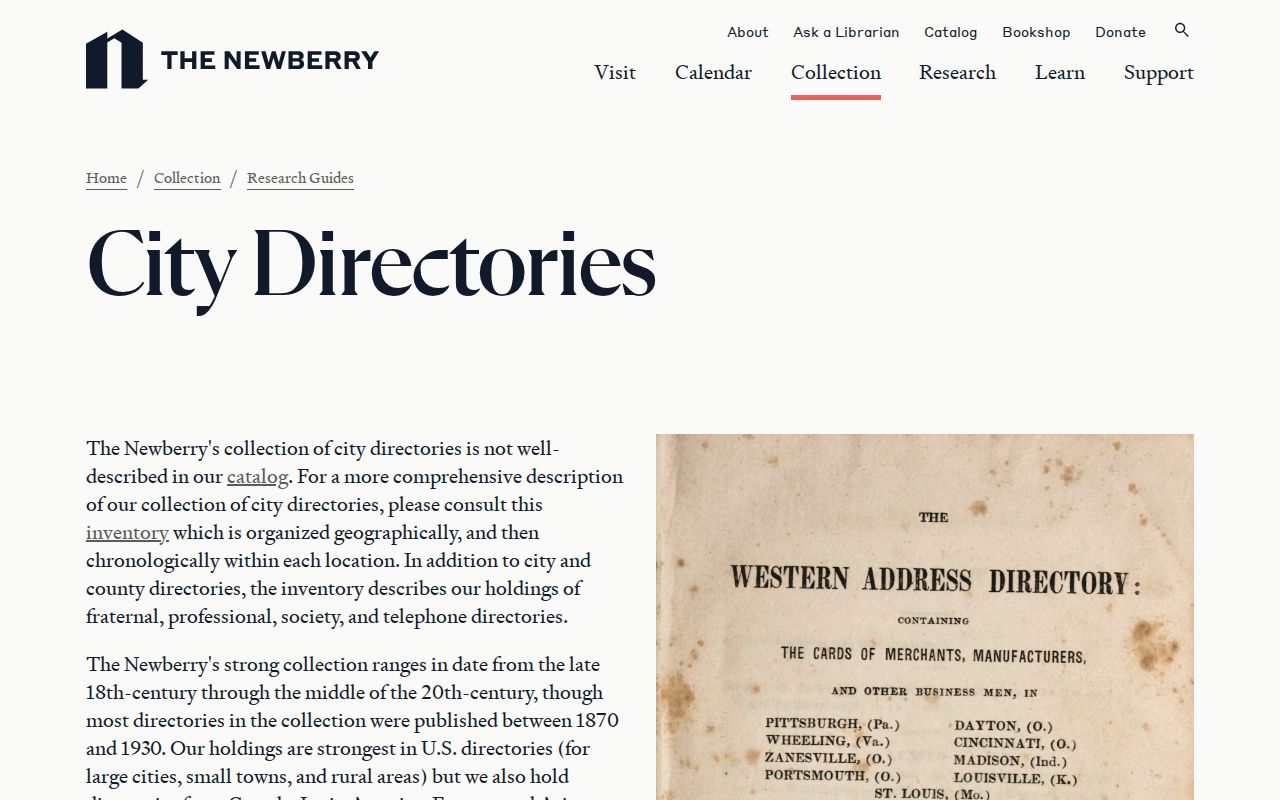
The guide is also the fallback when a name search fails. Browse the locality and street sections, try surname variants, and ask whether a regional volume files Dolton with Riverdale or greater Chicago.
Decode a Dolton Directory Entry
A scanned Polk page in Newberry's digital collection demonstrates the grammar common to city directories. Read the full line and the abbreviation key, not just the surname. A spouse or widow notation can distinguish households. An occupation and employer may explain why the same person appears at a business address and a home address. The letter “r” often marks a residence, while other short forms depend on that volume's key. The sample is a Chicago page, not a verified Dolton row, so its format guides reading rather than proving a specific Dolton fact.
| Name | Individual, initials, and spelling exactly as printed |
|---|---|
| Family notation | Spouse in parentheses or a widow reference |
| Work line | Occupation, employer, or business address |
| Residence | Street number and abbreviated street, sometimes with a residence marker |
| Extra clue | Telephone or association detail when that year included it |
- Criss-cross directory
- A later directory arranged by street address or phone number instead of only by surname.
- Householder index
- A list centered on the named head of a household, not a complete roll of everyone there.
- Abbreviation key
- The volume's legend for short forms, occupations, residence marks, and street names.
Dolton Records Before Incorporation
Dolton's official history puts George Dolton's settlement in 1835, a ferry in the early community, the first post office in 1866, and incorporation on December 28, 1892. Those dates explain a real search problem. An older source may use Dolton as a post-office or community label even though the modern village government did not yet exist. Township, county, route, and neighboring-place terms can be as important as the village name.
An early family should not be rejected merely because one source says Thornton Township or Riverdale. Compare the date, street, household, and map. The municipal label must fit the era. A current boundary should never be projected backward without a plat, directory, census geography, or other dated source.
| 1835 | George Dolton settlement named in village history |
|---|---|
| 1866 | First Dolton post office, before incorporation |
| 1892 | Village incorporation |
| 1922-1929 | Verified Dolton directory-year groups, with a gap after 1925 |
| 1974-1985 | Surveyed Dolton/Riverdale phone-book years |
Note: The timeline marks verified source points, not uninterrupted directory coverage between them.
Dolton Directory Names in Newspapers
A directory supplies a name-address clue; a newspaper may explain the person behind it. The state newspaper index records a changing sequence: Dolton Pointer, Dolton Pointer Economist, Dolton Economist Pointer, Dolton-Riverdale Economist Pointer, Riverdale-Dolton Economist Pointer, and later combined Calumet titles. Searching only “Dolton newspaper” can miss an obituary, school item, advertisement, or property event filed under a successor title.
The South Suburban society reports scattered Dolton/Riverdale Pointer material from 1917 through 1942. The state index is useful for title changes from 1970 through 1989. Search the person's exact name, initials, spouse, street, and nearby Riverdale or South Holland term. Cite the title, issue date, page, and spelling as printed. Newspaper context can support a match, but it does not turn an old address into a current residence.
Calumet Archives Extend Dolton Directories
The South Suburban Genealogical & Historical Society in Hazel Crest holds more than 14,000 items. Its library includes regional directories, family and church histories, yearbooks, local files, maps, telephone books, and a cemetery master index for 93 cemeteries with about 62,500 names. This is the best documented fallback when the Dolton city directory shelf stops. Call 708-335-3340 before a visit and ask for the exact surname, place, and year range.
Chicago Public Library's Calumet Region Community Collection adds 25 linear feet of material spanning 1850 through 2021, including 546 photographs, 22 oversize folders, and Dolton items. The collection is open at Harold Washington Library Special Collections. Its photographs and ephemera may confirm an institution, streetscape, or community event that a bare directory line cannot explain.
The Calumet Region collection finding aid outlines that regional scope.
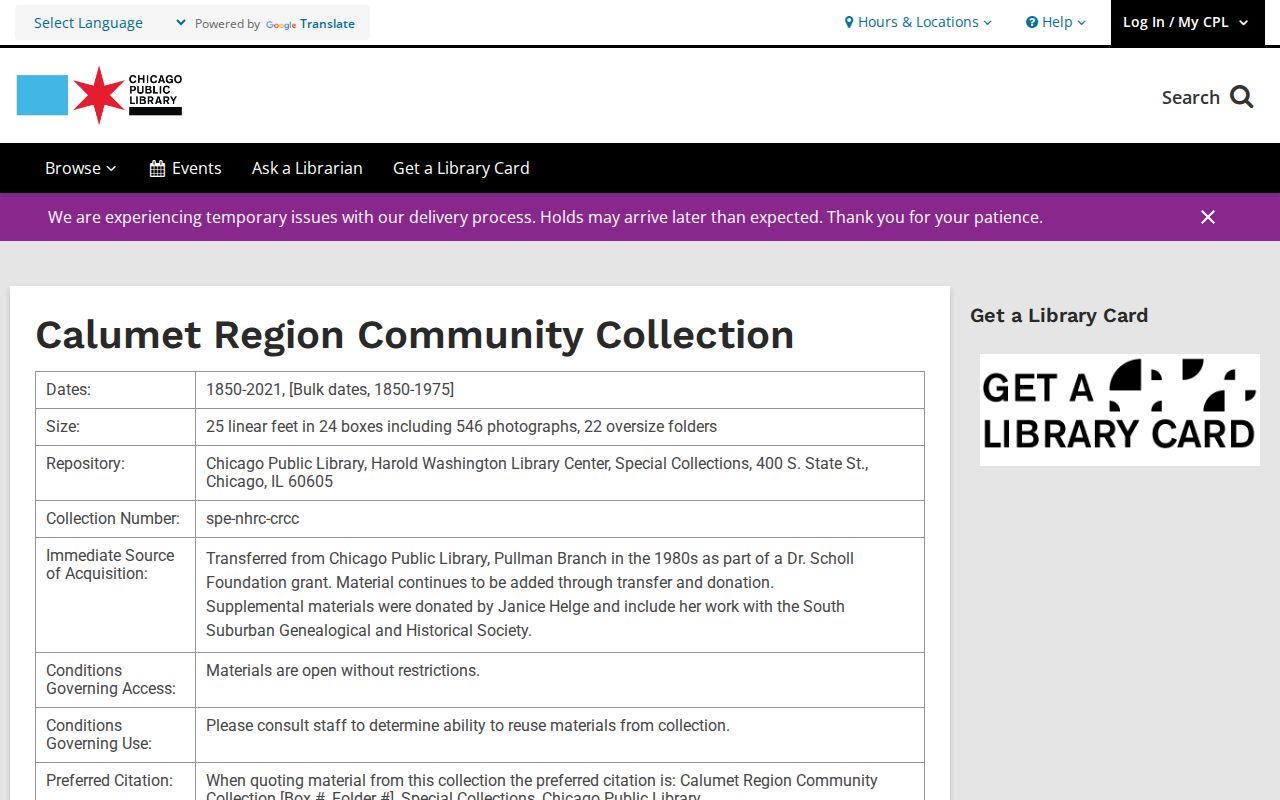
The regional label is useful evidence: Dolton material may be cataloged with the wider Calumet area rather than under one village heading.
Map Dolton Directory Addresses
Sanborn sheets for 1897, 1911, and 1950 can show a building footprint, use, material, lot arrangement, and street-number context. They do not identify each occupant. Federal census schedules add household order and relationships, but public release follows the 72-year rule and reaches 1950 in 2026. Census residence is tied to the enumeration date, not to a deed or current voter record.
Use a map nearest the directory year, then check township and enumeration geography. An address that fails today may reflect a changed lot, street form, or catalog label. No official source established a full Dolton renumbering timeline, so do not guess. Historic plats, the Village Atlas, and a Clerk request are the proper next steps.
Trace Families Through Dolton Directories
Family-history work is strongest when each fact has a date and source. Begin with one known person and one likely year. Record the printed spelling, page, street, spouse notation, and work line. Move forward and backward through available volumes instead of assuming the household stayed put. When the run ends, use the nearest census, Pointer title, cemetery entry, phone book, or map.
- Find the surname in a verified directory year and save the title page, page number, and abbreviation key.
- Check adjacent available years for moves, spelling changes, a new spouse notation, or disappearance.
- Search the street section when available, but do not call it a criss-cross index unless the volume identifies it that way.
- Pair the entry with the nearest released census and a dated newspaper or cemetery clue.
- Require two matching details before treating same-name entries as one person, and mark unresolved links as possible matches.
A disappearance can mean death, a move, a missed listing, or a gap in the collection. An obituary may close one trail. A later telephone book may reopen another. For modern address-keyed records, use the Dolton street directory rather than stretching an archival entry beyond its year.